

A bring back ex love spell is intended to focus your intention on renewed connection, but it cannot ensure your ex will return. Their feelings and choices remain their own. If you choose a ritual, be clear about what you hope for while staying grounded in that reality.
A breakup can leave you looking for a way to reconnect and unsure which ritual fits your situation. This guide explains what return-lover spells aim to do and how to choose one based on why the relationship ended. You’ll also learn how to personalize a ritual with meaningful memories, prepare with focus, and be patient without losing sight of your own well-being.
Key Takeaways
- Choose a ritual with a clear intention, while respecting your former partner’s feelings and choices.
- Consider why the relationship ended before deciding what kind of reconnection you hope to encourage.
- Use shared memories or meaningful personal objects to make the ritual feel personal and focused.
- Prepare a peaceful space and center your attention before beginning, rather than acting from panic.
- Give the process time, and avoid piling on rituals for the same purpose.
1. A spell intended to bring an ex back
A bring back ex love spell is meant to focus your intention on renewed contact, affection, or reconciliation. It cannot make another person return or choose a relationship. Their feelings and decisions remain theirs. Treat the ritual as a spiritual practice, not proof of what your former partner feels.
In the United States, whether conduct is lawful depends on what happens beyond the ritual. Keep spiritual practice separate from repeated unwanted contact, threats, deception, or taking someone’s belongings. Respect boundaries and applicable law in every interaction.
Are there risks to using a spell to influence an ex-partner? Yes. A ritual can intensify longing or encourage you to ignore a clear boundary, especially if you treat silence as a reason to keep pursuing someone. Set a limit before beginning: don’t use a spell as permission to pressure, monitor, or contact an ex who asked for space.
How can you tell if a love spell practitioner is a scam? Treat guaranteed results, urgent demands for escalating payments, and threats of harm unless you pay as serious warning signs. A trustworthy description should explain what the ritual aims to do without promising control over another person’s choices.
Are love spells legal in the United States? The ritual itself isn’t a single yes-or-no legal category; the conduct around it matters. Keep related communication honest and respectful, and don’t treat spiritual beliefs as an excuse to cross someone’s boundaries.
What are healthy alternatives to trying to bring back an ex? Start with a pause, write down why you want reconciliation, and consider what would need to change. Talk with someone you trust or focus on routines that support your well-being. If the breakup involved fear or harm, prioritize safety rather than reunion.
How can you contact an ex respectfully after a breakup? Send a calm message that states your purpose, such as asking whether they’re open to talking. Avoid guilt, pressure, and repeated follow-ups. If they decline or don’t respond, accept that boundary instead of interpreting silence as hidden consent.
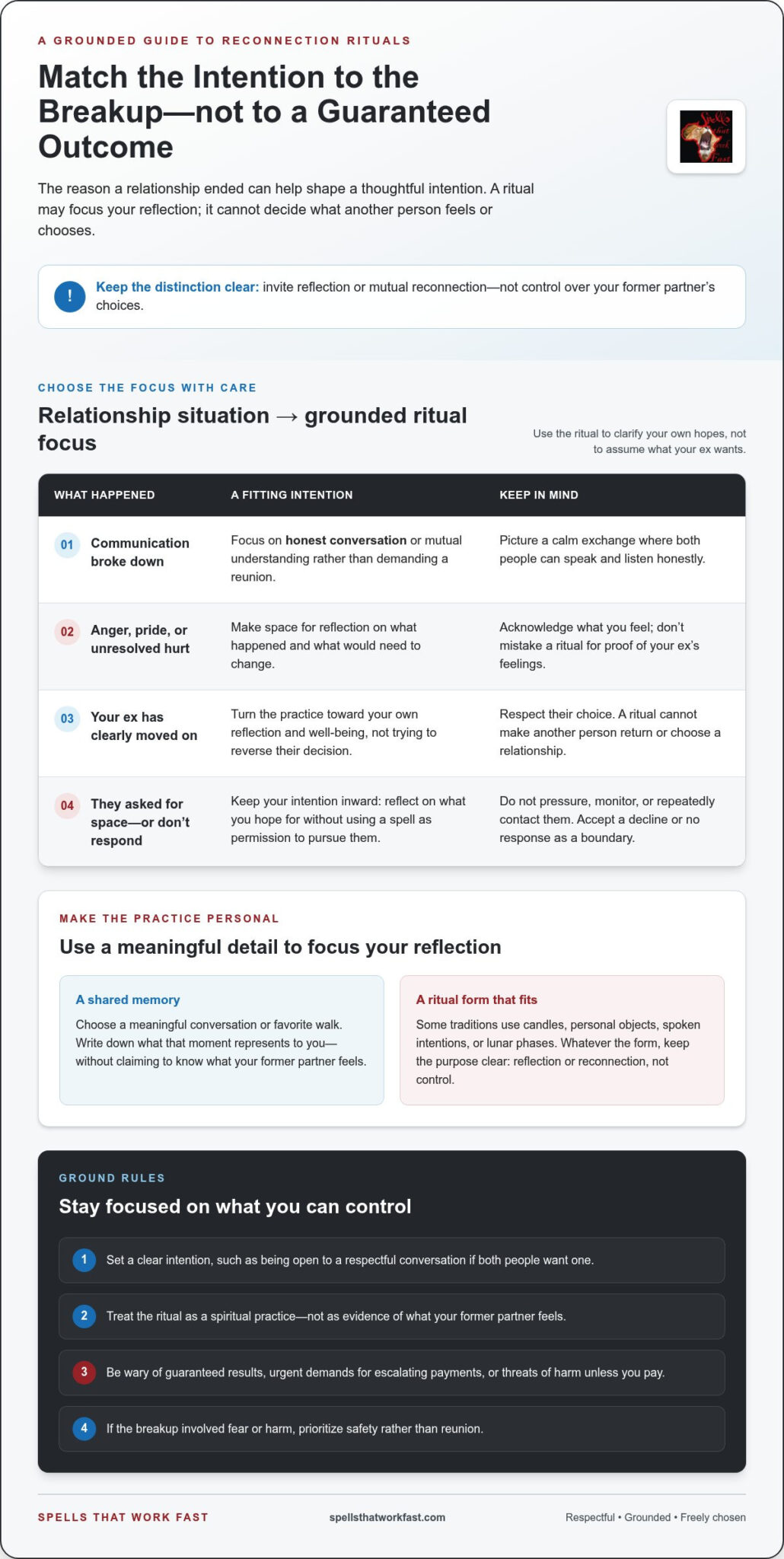
Choose a ritual based on its intention and the reason the relationship ended. Anger, pride, poor communication, and unresolved hurt call for different reflection than a breakup where someone has decided to move on. For example, if communication broke down, focus your intention on honest conversation rather than forcing a reunion. If your ex has clearly moved on, respect that choice.
Some traditions connect rituals with lunar phases, while others use candles, personal objects, or spoken intentions. White magic is described as working without imposing the caster’s wishes on another person’s free will. Whatever form you choose, keep the purpose clear: invite reflection or reconnection, not control. A ritual can support your focus, but it cannot establish what your ex wants. Use that distinction to make a grounded decision before you begin.
2. Energy, vibrations, and emotional focus
In love-spell traditions, energy often means the attention and emotion a person brings to a ritual. A practitioner who offers love spells may describe them as amplifying feelings that already exist, rather than creating affection from nothing. This belief makes emotional focus central: clarify whether you seek an honest conversation, mutual understanding, or reconciliation before you begin.
Try this brief preparation step. Write one intention in plain language, such as, “I’m open to a respectful conversation if we both want one.” Read it once, then consider whether it reflects care or an attempt to control your ex. If the wording demands a particular response, revise it. A focused intention gives the ritual a clear purpose without turning your former partner into an object.
Dew described using a candle ritual with visualization, emotion, and structure. In that account, the candle was not the whole practice; the person’s attention and chosen imagery mattered too. Apply that idea by picturing a calm conversation, not a scene where your ex behaves exactly as you wish. Imagine listening, speaking honestly, and accepting the other person’s actual response.
Keep the practice specific. Sit somewhere quiet, set your intention, and take a moment to name the emotion you feel. If anger dominates, acknowledge it instead of pretending to feel only love. If sadness is present, let it be part of your reflection. Naming an emotion can help you separate what you feel from what you hope your ex will do.
Dew also said they learned that letting go mattered to both their magical practice and mental health. That doesn’t mean denying affection. It means releasing the demand that a ritual must produce one exact outcome. After your practice, choose one grounded action, such as journaling about what would need to change for reconciliation to work.
Before repeating the ritual, ask yourself: does the practice leave you calmer and clearer, or more distressed and fixated? If checking your ex’s activity or waiting for a message takes over your day, pause and return to ordinary routines. A walk, a meal with a trusted friend, or writing down your thoughts can bring your attention back to your own life.
Your emotional focus is strongest when your intention, words, and actions agree. For example, wishing for a respectful reconnection while sending repeated messages creates a mismatch. Let the ritual reflect the relationship you want: mutual, honest, and freely chosen. That standard gives your practice direction while keeping your attention on what you can control.
3. Personalizing rituals with shared memories or items
A shared detail can make a ritual feel specific rather than generic. Choose a memory that reflects the connection you hope to revisit, such as a meaningful conversation or a favorite walk. Write down what that moment represents to you. Keep the focus on your feelings, not on claiming to know what your former partner feels.
A meaningful location can also guide your intention. If you shared a quiet park bench, picture that place as you reflect on what made the relationship feel supportive. You don’t need to visit the location or contact your ex. Use the memory as a prompt: what quality do you want to invite back, such as patience, honesty, or warmth?
Some white magic traditions describe a love-binding ritual using photos of both people and a red ribbon tied around them. Treat it as a symbolic practice, not a way to bind someone’s choices. If you adapt the idea, use images you already have permission to keep, and set an intention for mutual understanding rather than control.
Choose personal items with care. A shared keepsake you already own can represent a memory, but don’t take or use your ex’s belongings without permission. For example, a ticket stub from a concert you attended together can remind you of a joyful experience. Avoid intimate or private materials; a ritual should never depend on violating anyone’s privacy.
Make the symbolism clear before you begin. Place your chosen item beside a written intention, then read it once. You might write, “I welcome an honest conversation if we both choose it.” This wording connects the memory to a respectful possibility instead of demanding a particular response or reunion.
Keep the ritual simple enough to stay focused. One photo, one written memory, or one familiar object can be more meaningful than a pile of unrelated items. Ask yourself what each object represents. If you can’t explain its connection to your intention, leave it out. A carefully chosen symbol gives you a practical point of focus.
Afterward, put the item away instead of using it to monitor your ex or fuel repeated contact. If a photograph leaves you distressed, choose a written memory instead. Personalization should help you reflect on the relationship and your hopes. It should never turn a keepsake into proof of your ex’s feelings or permission to ignore their boundaries.
Personalize the ritual with shared memories, meaningful locations, or personal items, choosing whatever connects most naturally to your intention.
4. Advice on spell preparation and patience
Common reconciliation rituals use a quiet space, a candle, visualization, and a spoken intention. Some practitioners also use crystals or incense to mark the ritual’s focus. Before beginning, clear a stable surface, gather only the items your chosen practice needs, and write one clear intention. For example, invite an honest, mutual conversation rather than demanding that your ex return.
Prepare the space before lighting a candle. Move distractions aside, silence your phone, and place the candle on a stable, heat-safe surface. Keep the ritual simple. A peaceful setting helps you focus on the words and images you chose, rather than turning preparation into a frantic search for extra objects.
Visualization gives your intention a concrete shape. Picture a calm conversation with your former partner, with both people speaking and listening. Don’t imagine a scene that erases their preferences or forces a particular answer. If your mind jumps to an argument, pause, breathe, and return to the respectful conversation you want to invite.
What are common rituals or steps in a reconciliation spell? Practitioners may prepare a peaceful space, light candles, use crystals or incense, visualize a reunion, and speak an intention. Choose steps that fit the ritual, then focus on carrying them out calmly rather than adding unrelated materials.
After the ritual, patience means resisting the urge to repeat it immediately. Some guidance recommends daily support for a spell, while also advising against casting multiple spells for the same purpose. If you choose a daily practice, keep it consistent and brief, such as revisiting your written intention. Don’t interpret every message, coincidence, or silence as evidence of a result.
How long a ritual takes can depend on its materials and the commitment involved. A practice with several items and repeated steps may take longer than a brief ritual. That difference describes the work involved, not a timetable for your ex’s actions. Keep expectations grounded in what you can control: your preparation, focus, and choices.
Guidance from an experienced spellcaster may help you understand a ritual’s steps and keep its purpose clear. Look for explanations that describe the process plainly, without pressure to add more spells or materials. A steady practice should not become a reason to put your daily life on hold. Keep up with sleep, work, meals, and time with supportive friends while you wait.
What should you do if your ex has asked you not to contact them? Respect that request and don’t send messages, gifts, or indirect messages through friends. Keep any ritual private and focused on your own reflection, not on creating a reason to break their boundary.
5. Choosing a spell based on why the relationship ended
Start with the breakup itself, not the first ritual you find. Anger, pride, poor communication, and unresolved hurt can each shape what reconciliation would require. Write down the main reason you separated, then name one change that would make reconnecting healthier. If arguments grew from misunderstandings, your intention might focus on calm, honest dialogue rather than immediate reunion.
For a breakup shaped by poor communication, choose a ritual intention centered on clarity. Picture both people explaining their needs without blame, then ask yourself what you would say differently in a real conversation. A ritual focused on listening and honesty gives your reflection a practical direction, instead of treating one message as proof that the relationship has changed.
If pride or anger drove the split, examine your own part before setting an intention. Write one sentence accepting responsibility for a specific action, such as dismissing your ex’s concern. A ritual can mark your wish to approach the issue with humility. It can’t replace an apology, changed behavior, or a genuine willingness from both people to talk.
Unresolved hurt calls for care, not pressure. List the issue that remains painful, such as a broken promise or a repeated argument. Then decide whether reconciliation would require an honest discussion, a clear boundary, or time apart. Let that answer shape your intention. If the same harmful pattern continues, a reunion alone won’t resolve its cause.
Some breakups happen because one person has decided to move on. That differs from a separation caused by a misunderstanding or a conflict both people want to repair. Don’t choose a ritual intended to force an outcome. Keep the focus on your own clarity and readiness to accept a freely chosen response.
Before trying to reconnect, consider whether a conversation is appropriate. Guidance for a stubborn get-back-together spell recommends having an important conversation with your ex first. If contact is welcome, prepare a calm opening that names the issue without accusation. For example, “I’ve thought about how we handled our disagreements. Would you be open to talking?” If they decline, respect that answer.
Use the reason for the breakup to set a meaningful goal: clearer communication, accountability, or mutual understanding. A focused intention can help you reflect on what needs to change before reunion becomes a healthy choice. If you want a ritual aligned with that intention, explore a focused love-spell approach and keep the goal grounded in mutual respect.
Consider whether the reason reflects anger, pride, poor communication, unresolved hurt, or one person’s decision to move on. Let that guide your intention.
Spells That Work Fast: Instant Love Spells That Work Fast
Spells That Work Fast offers Instant Love Spells That Work Fast for people seeking spiritual support around love and reconnection. After considering why the relationship ended, you can turn to this offering when you want a love-focused ritual as part of your personal practice. Keep your intention centered on openness, honest communication, and mutual choice. A spell cannot replace respecting your ex’s boundaries or deciding what changes would make a reunion healthier. The next step is simple: visit Spells That Work Fast to learn more about its love-spell offering.
Choose Your Next Step With Care
The next step is not to rush toward a reunion. Decide what you need to feel respected, what you’re willing to change, and what you’ll do if your ex doesn’t want to reconnect. That clarity can help you face the future without making your well-being depend on one response.
If a bring back ex love spell feels meaningful to you, let it support reflection rather than replace honest choices. No ritual can guarantee another person’s return. Keep your intention grounded in mutual respect, and give yourself room to choose a path that feels right even if the relationship doesn’t resume.
When you’re ready to explore spiritual support for love, contact Spells That Work Fast. Take the next step with a clear intention and an open mind. You deserve care, clarity, and a future shaped by choices that honor you.
Frequently Asked Questions
Are return lover spells effective?
Return-lover spells are spiritual practices, not reliable ways to determine what another person will do. People may describe personal experiences, but one person’s story can’t show that a ritual caused an ex to reconnect. Consider what “effective” means to you: a clearer intention, a sense of focus, or renewed contact. Only the last outcome depends on both people choosing to communicate.
Do spells to bring back an ex-partner last long?
There’s no standard duration for a spell’s influence or for a renewed relationship. Ritual traditions describe duration differently, and practices involving more preparation can differ from brief rituals. A relationship’s future depends on what both people choose and how they address the issues that led to the breakup. Don’t treat a claimed timeline as proof that a lasting reunion will happen.
Where is the best place to get correct information about a powerful love spell to bring her back?
Look for a clear explanation of a ritual’s purpose, steps, and limits, not language promising control over someone’s feelings. For information about the service offered here, read the details for Instant Love Spells That Work Fast. Compare the description with your intention, and be cautious of anyone who uses fear, pressure, or claims of guaranteed results to influence your decision.
What is a spell to bring back an ex supposed to do?
A return-lover spell is intended to focus spiritual attention on renewed affection, communication, or reconciliation. For example, someone might use a ritual to express hope for a sincere conversation after a breakup. That intention describes the practitioner’s aim, not a confirmed effect on the ex-partner. It cannot establish whether the other person wants contact or a renewed relationship.
Do love spells to bring back an ex work, according to evidence?
Personal accounts don’t establish that a love spell causes an ex to return. Dew reported receiving a text from an ex saying he missed them five days after performing rituals. That account describes a sequence of events, but it can’t show what caused the message or predict what will happen in another relationship. Treat testimonials as individual stories, not proof of an outcome.