

A spellcaster who states the fee upfront and doesn’t change it once the work begins gives you a clearer basis for deciding than one who keeps asking for more. Knowing how to tell if a spellcaster is authentic or fake starts with watching for surprise charges, especially requests for extra money to remove a newly claimed spiritual obstacle. A clear price alone can’t prove authenticity, so consider the whole picture before you pay.
It makes sense to want clarity before trusting someone with money or a personal concern. This guide will help you assess payment requests, online profiles, testimonials, written explanations, and pressure tactics so you can spot warning signs and make a considered decision. Start with the fee, then see whether the spellcaster communicates clearly and consistently throughout your interactions.
Key Takeaways
- Pause if a spellcaster asks for more money to remove a newly claimed spiritual obstacle; treat changing payment demands as a serious warning sign.
- Look for testimonials that sound unusually alike, and assess whether the online profile feels consistent and credible.
- Favor written explanations that clearly describe the work over vague language that avoids practical details.
- Be wary of guaranteed outcomes, secrecy demands, and pressure to pay or decide quickly.
1. Repeated requests for additional payments
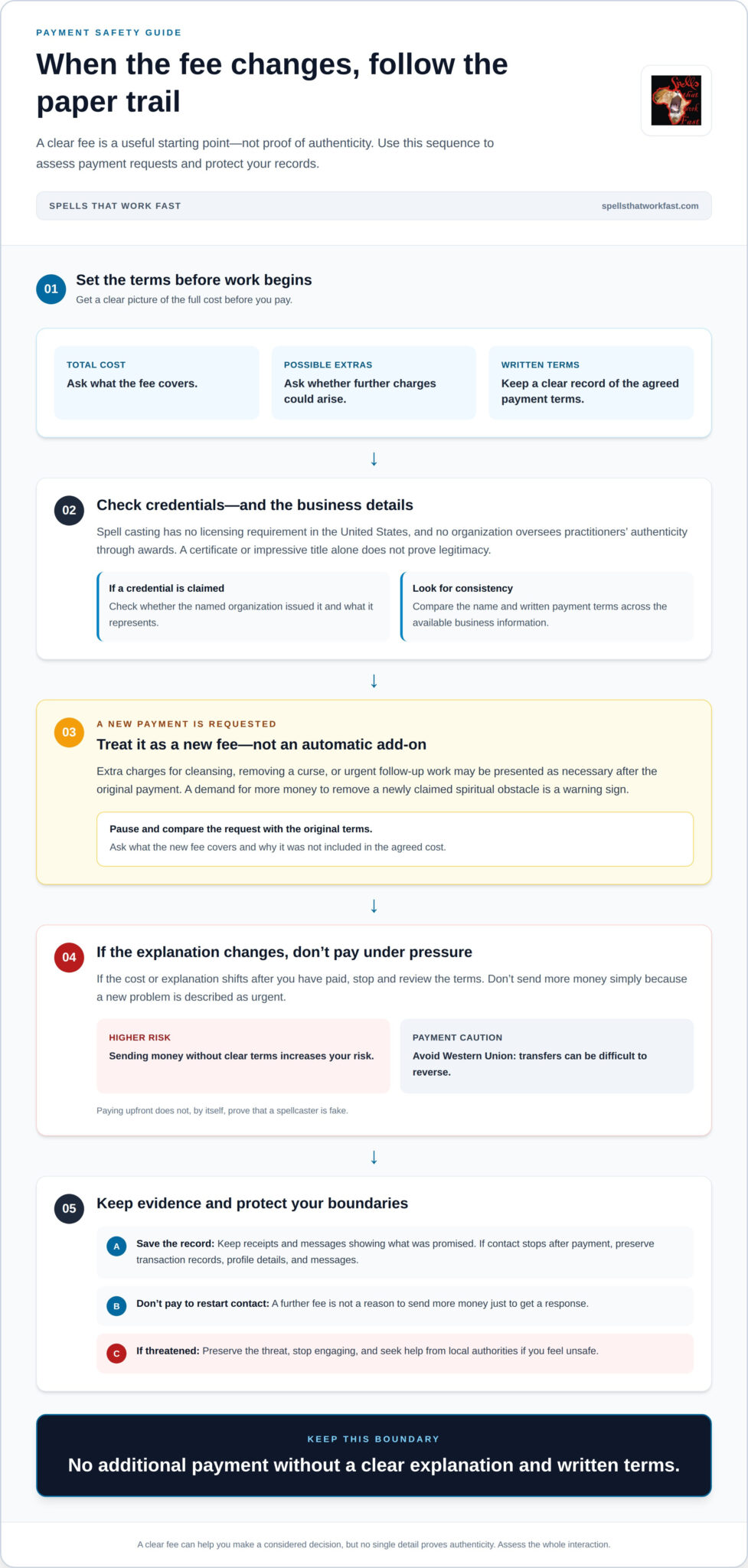
Agree on the fee before a spell begins. A warning sign is a new demand after payment, especially if the spellcaster says extra money is needed to remove spiritual obstacles or extraordinary negative energies. Ask for the total cost, what it covers, and whether further charges could arise. If the explanation changes after you pay, don’t send more money under pressure.
Spell casting has no licensing requirement in the United States, and no organization oversees practitioners’ authenticity through awards. A certificate alone therefore doesn’t prove someone is legitimate. If a spellcaster claims a credential, check whether the named organization issued it and what it represents. Look for clear business information, such as a consistent name and written payment terms, rather than relying on a badge or impressive title.
Spiritual-service scams may involve extra charges for cleansing, removing a curse, or urgent follow-up work. Treat these as new fees, not automatic parts of the original service. Before paying, review the total cost and any ongoing or hidden charges. Avoid Western Union for spellcaster payments: a transfer that’s difficult to reverse can leave you with little recourse if the recipient disappears. Keep receipts and messages showing what was promised.
Paying upfront doesn’t prove a spellcaster is fake, but sending money without clear terms increases your risk. If the person stops responding after payment, save transaction records, profile details, and messages. Don’t pay another fee to restart contact. If a spellcaster threatens you or demands more money, preserve the threat, stop engaging, and seek help from local authorities if you feel unsafe. Set a firm boundary: no additional payment without a clear explanation and written terms.
2. Assessing online profiles and testimonials
Read a spellcaster’s profile as a set of claims, not proof. Compare the name, profile photo, service description, and payment identity wherever they appear. For example, a profile using one name while its payment page uses another deserves closer scrutiny. A mismatch may have an ordinary explanation, but don’t ignore it. Look for consistent information about the services and how to reach the person.
How can you check reviews and spot fake testimonials? Compare several reviews for repeated phrases, identical spelling, or the same dramatic promise. Similar wording may mean one person wrote multiple testimonials. Automated comment robots can also post hundreds of false testimonials across blogs, forums, and websites, so a large review count alone proves little.
Look for specific details rather than sweeping praise. A review that says only “powerful,” “fast,” or “guaranteed” gives you little to assess. More useful accounts explain what service the person sought and describe the interaction in their own words. Still, detail isn’t proof on its own. Treat each testimonial as one clue, then compare its wording and claims with the profile and other reviews.
Check whether praise appears in different places and sounds distinct. Testimonials with near-identical sentences are less persuasive than varied accounts describing different experiences. Notice whether comments repeat an unusual phrase, promise identical outcomes, or appear clustered together. Polished writing alone doesn’t prove fraud, either. Focus on repeated patterns and contradictions, such as a profile describing one service while reviews promote another.
Use this process to assess testimonials without letting a high rating make the decision for you. For another point of comparison, read real-life spell testimonials and notice how individual accounts differ in wording and detail.
3. Evaluating a spellcaster’s written content
Read the spellcaster’s explanations before relying on testimonials or bold claims. Clear writing should explain what the work involves, what the service focuses on, and what information the practitioner needs from you. Compare details across the main page, service descriptions, and written messages. If one page describes a focused ritual while another promises to solve every personal problem, note the mismatch. To tell if a spellcaster is authentic or fake, check whether the written claims stay consistent.
Vague language can make it hard to understand what you’re being asked to pay for. Phrases such as “powerful energy,” “ancient secrets,” or “guaranteed transformation” sound forceful but explain little. Look for plain answers to practical questions: Does the text describe the purpose of the work, the steps involved, and what happens after you provide the requested details? If those basics remain unclear, pause before committing.
Compare the claims with the process described. A page might promise a love spell, while its instructions discuss money or protection instead. That gap doesn’t prove fraud, but it gives you something specific to clarify. Watch for explanations that shift between messages, such as a simple service becoming an urgent, complex problem requiring extra work. Save the original description so you can compare it with later messages.
Use a simple reading check: identify the promised service, the actions described, and the limits the writer acknowledges. If you can’t tell what the spellcaster proposes to do after reading the relevant page twice, the explanation isn’t clear enough for an informed decision. A useful way to tell if a spellcaster is authentic or fake is to weigh the details, consistency, and directness together. Polished writing alone proves nothing.
4. Warning signs of fake spell casters
Watch for promises that are both precise and guaranteed. An example is a claim that an ex will return in exactly seven days, or that every spell produces 100 percent results quickly. A spellcaster cannot responsibly guarantee a specific outcome. Treat certainty about another person’s choices, wealth, or timing as a pressure tactic, not evidence of skill.
Urgency is another warning sign. A message insisting you must pay immediately, keep the interaction secret, or risk a curse uses fear to push your decision. Don’t let a deadline replace clear information. Save the message, step away, and decide only after the pressure stops. A practitioner who asks you to hide the interaction is asking you to cut off outside perspective.
Look at the website’s history as well as its claims. Check the domain’s registration date and archived versions of its pages. A sudden online presence making sweeping promises deserves careful scrutiny. Compare older descriptions with current ones. A sharp change in the named practitioner, service, or claims can reveal inconsistencies. A new website alone doesn’t prove fraud, but gives you less history to assess.
Be cautious of anyone claiming they can do anything or guarantee every result. A credential matters only if the named organization can independently verify it. Spell casting has no licensing requirement, so don’t mistake a title or certificate for official oversight. Consider the full pattern: unsupported guarantees, secrecy, rushed decisions, and shifting claims carry more weight together than any one isolated detail.
Use a simple rule: pause when fear or urgency replaces a clear explanation. If your goal is financial, explore a money-focused spell option without treating any spell as a guaranteed result.
Spells That Work Fast: Powerful Money Spell To Attract Wealth Instantly
Spells That Work Fast offers Powerful Money Spell To Attract Wealth Instantly for people seeking spiritual support around a financial goal. Consider it when your intention is focused on wealth, not as a substitute for practical money decisions or as a guarantee. A clear intention can help you focus on what you want to work toward, while careful judgment still matters when evaluating any service. Keep the same standards from this guide: look for clear communication, consistent information, and no pressure to make a rushed decision. Choose a service that fits your concern and take time to decide what feels appropriate.
Contact Spells That Work Fast to discuss your interest.
Choose a Next Step That Fits Your Intention
Let your next step come from clear intention, not fear or pressure. The best way to tell if a spellcaster is authentic or fake is to use calm judgment: choose support that speaks directly to your goal, and take time to decide what feels right for you.
For spiritual support focused on love, finances, or business growth, Spells That Work Fast offers Instant Love Spells That Work Fast, Powerful Money Spell To Attract Wealth Instantly, and Spells For Business Growth Support and Success. Each offering addresses a different intention, so start with the concern that matters most to you. Spell results aren’t guaranteed, so keep your expectations grounded as you consider your choices.
If you’re ready to discuss your intention, contact Spells That Work Fast. Take the next step at your own pace, with a clear goal and confidence in your decision.
Frequently Asked Questions
How can I tell if a spell caster is a scam?
Watch for a pattern of misleading claims or demands that keep changing after you agree to a service. For example, if the original offer describes one focused working but later messages introduce unrelated problems requiring new payments, stop and reassess. Keep copies of the offer and messages. Judge the full interaction, not one unusual phrase or a polished profile, before deciding whether to continue.
How do I check if a spell caster is legit?
Check whether the person’s identity, service description, and communication remain consistent from first contact through payment. Before proceeding, make sure you can explain in your own words what you’re paying for and what the practitioner says they will do. If the conversation leaves you confused about the basic arrangement, pause rather than relying on confidence, dramatic language, or spiritual terminology.
Should a spell caster guarantee results?
No. A spellcaster shouldn’t guarantee a specific result, because a ritual cannot ensure another person’s choices or control every event affecting your situation. A love spell, for example, should not be presented as a way to force someone to return or love you. Treat promises of certain outcomes as a reason to step back, and look for language that separates intention from what no practitioner can promise.
What are common red flags of a fake spellcaster or psychic scam?
Red flags include threats, demands for secrecy, pressure to decide immediately, or requests for sensitive account credentials. Never share bank logins, passwords, or security codes as part of a spiritual service. If a message threatens harm unless you pay, save a copy and don’t respond under pressure. A frightening claim isn’t proof that the sender can cause the event they describe.
How can I verify a spellcaster’s credentials, experience, or reputation?
Check a claimed credential with the organization named on it, and find out what it represents. A training certificate, for example, may show course completion, not proof of spell results. For claims about experience, look for specific, consistent details rather than relying on a title alone. Reputation takes more than praise: consider whether independent accounts describe the practitioner’s conduct consistently.
How do authentic spiritual practitioners describe what a spell can and cannot do?
Responsible explanations distinguish a spell’s intention from outcomes outside the practitioner’s control. A practitioner might describe a wealth spell as focused on financial intention, not guaranteed income. A love spell shouldn’t be framed as control over another person’s feelings. Clear limits help you understand the service without mistaking spiritual language for a promise about what will happen.