


A money spell is intended to focus an intention around income, opportunity, or prosperity, not replace practical financial decisions. Your money spell questions before contacting a practitioner should begin with your purpose and the instructions for the specific ritual. Some practices call for the first day of the month, Thursday or Sunday, or a new moon; timing depends on the spell’s directions.
It’s reasonable to want clear guidance before beginning. Spell jars, candle rituals, and other practices can have different directions, so don’t assume one set of steps applies to every option. Be clear about the change you hope to invite, whether that means focusing on personal finances or business growth.
This guide explains what money spells are for, when different rituals may be performed, how directions vary, and what to consider before you begin. You’ll have a clearer basis for discussing your goal and deciding whether a money spell fits your situation.
Key Takeaways
- Match timing to the specific ritual: options may include the first day of the month, Thursday or Sunday, or a new moon.
- Define whether your intention is about personal income, new opportunities, or business growth before discussing a spell.
- Expect directions to vary by ritual or spell jar, and follow the instructions for the option you choose.
- If a money spell service seems like a scam, stop interacting, don’t send money or personal information, and contact your financial institution.
How a practitioner determines the best timing for the spell
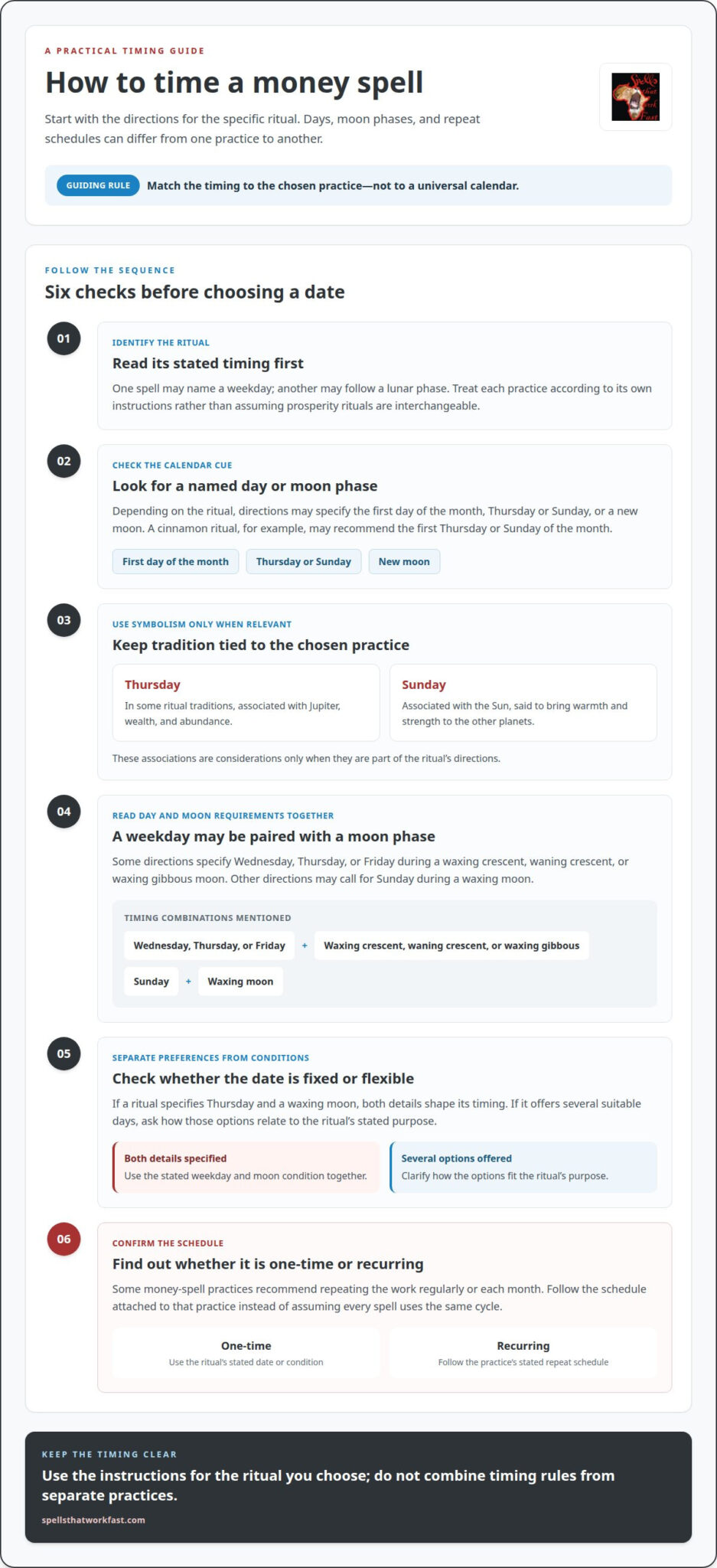
- Start by identifying the specific ritual and its stated timing. Directions vary: one spell may call for a particular weekday, while another follows a lunar phase. Timing should match the instructions for that practice, rather than treating every prosperity ritual as interchangeable.
- Check whether the practice names a day of the month. Some rituals may be performed on the first day of the month, Thursday or Sunday, or during a new moon. For a cinnamon ritual, one recommendation is the first Thursday or Sunday of the month.
- Consider symbolism only when it is part of the chosen practice. In some ritual traditions, Thursday is associated with Jupiter, wealth, and abundance. Sunday is associated with the Sun, which is said to bring warmth and strength to the other planets.
- Read weekday and moon-phase requirements together. Some spell directions call for Wednesday, Thursday, or Friday during a waxing crescent, waning crescent, or waxing gibbous moon. These differ from directions that call for Sunday during a waxing moon, so follow the timing specified for each ritual.
- Distinguish a preferred date from a required condition. If a ritual specifies Thursday and a waxing moon, both details shape its timing. If it offers several suitable days, ask how those options relate to the ritual’s stated purpose.
- Consider whether the practice is intended as a one-time ritual or a regular focus. Some money-spell practices recommend repeating the work regularly or each month. Follow the schedule attached to that practice rather than assuming every spell follows the same cycle.
Meaning and purpose of money spells
Set a clear purpose before discussing a ritual. Focus on the kind of financial change you hope to encourage, not an outcome that a practice cannot promise.
- Define your intention in practical terms. You might want to focus on income opportunities, steadier business growth, or prosperity. A specific aim makes it easier to discuss the ritual’s purpose.
- Separate spiritual intention from financial planning. A spell jar or ritual tool may help focus attention on an intention, but it cannot guarantee a specific financial outcome. Base spending, saving, and business decisions on your actual circumstances.
- Distinguish spiritual language from a claim of financial return. A money spell is a spiritual practice, while a promise of financial returns is a separate representation. Whether such a representation is legally regulated depends on the circumstances, so don’t treat spell language as a legal or financial guarantee.
- Explain what prosperity means in your situation. It may mean pursuing new work opportunities or, for a business owner, focusing on growth. These examples clarify your purpose without confusing intention with a promised result.
- Ask how the service relates to your stated goal. Spells That Work Fast can explain the purpose and approach of its money-focused work in plain language. The price depends on the case and is provided after a quote request; factors include the service’s scope, requested focus, and work involved.
- Keep practical action in view. A money-spell intention can sit alongside budgeting, pursuing opportunities, or building positive financial habits. These steps address real-world choices while the ritual supports focus and intention.
- Decide whether the purpose fits before proceeding. A spiritual ritual cannot guarantee a specific financial result. If your aim is to focus on prosperity while taking practical steps, describe that aim clearly in your discussion.

How practitioners explain product-specific directions to clients
- Identify the format before discussing how to use it. A ready-to-use spell jar differs from a candle ritual or money bowl. Follow the directions for the specific practice rather than combining steps from separate rituals.
- Clarify whether anything needs to be added to a jar. If it is described as ready to use, its directions say not to add anything extra. Some jars include a printed spell card with guidance. Ask how the card relates to the jar’s intended purpose.
- Make your intention easy to understand. Some directions recommend writing it as a simple sentence in positive, present-tense language. For example, “I welcome new income opportunities” states a clear focus without promising a specific financial result.
- Explain how a jar serves as a reminder. Directions may suggest keeping it nearby, such as in a pocket, bag, or workspace. The practitioner clarifies whether this instruction applies to that jar, rather than assuming every ritual tool should be carried.
- Treat a money bowl as a distinct practice. Its directions may call for rice and salt at the bottom, with a candle placed in the middle. Each item represents part of the ritual, and you may state or think about an intention as you add items.
- Follow any ongoing-care directions in plain terms. Money bowl instructions may recommend interacting with it each day and adding an offering, such as a coin, rice, spice, or essential oil. They may also suggest refreshing it monthly or seasonally.
- Keep ingredient options specific to the directions for the chosen practice. A money bowl may use coins or dollar bills as symbols, along with citrine, pyrite, or green aventurine. Possible herbs include basil, cinnamon, pumpkin pie spice, or a dried bay leaf. Not every item is required for every ritual.
Follow the directions provided with the chosen spell jar; if it is described as ready to use, add nothing extra. The spell calls for swirling the bay leaf three times clockwise in cinnamon water, with a pinch or two of ground cinnamon, and recommends performing the money spell on Sunday during a waxing moon. Keep the jar nearby as a reminder of your financial intention. The author recommends waiting until the next day to sweep the area inside the front door.
Questions to consider before starting
Use these money spell questions before contacting a practitioner to assess the process, protect your information, and decide what fits your situation.
- When comparing practitioners, review their stated experience, process, and available client reviews. Look for clear descriptions of the work rather than broad claims about results. Write down your money spell questions before contacting a practitioner so you can assess how clearly the service is explained.
- Ask what the spell is intended to focus on, what the process involves, and what instructions you’ll receive. Clarify what the service does and doesn’t promise, and note whether the answers match your financial goal.
- Watch for pressure to pay immediately, requests for sensitive information, or claims of guaranteed wealth. If you suspect a scam, stop interacting, don’t send money or personal information, and contact your financial institution, according to the Internal Revenue Service.
- Protect your private information. Don’t share account passwords, bank login information, or other sensitive financial access with a spell caster. Explain your goal without revealing information that could put your accounts at risk.
-
Clarify Payment and Refund Terms
Ask which payment methods are accepted, when payment is due, and what written refund terms apply. Clarify what happens if the service is cancelled, which circumstances qualify for a refund, and whether conditions apply. Keep the terms and payment records together. Don’t pay under pressure or rely on an unclear verbal promise.
-
Consider Risks and Practical Alternatives
Consider personal and financial risks before committing. A spell service shouldn’t require access to your financial accounts or sensitive credentials. Instead of paying for a spell, you can review your budget, pursue income opportunities, or build positive financial habits. These actions address practical choices directly, whether or not you pursue spiritual support.
If you’re ready to discuss your intention, contact Spells That Work Fast.
Spells That Work Fast: Powerful Money Spell To Attract Wealth Instantly
Spells That Work Fast offers Powerful Money Spell To Attract Wealth Instantly for people seeking spiritual support focused on prosperity. Consider it when your intention is clear and you want to discuss a money-focused spell rather than general financial advice.
Before proceeding, explain the financial change you want to focus on and ask about the spell’s purpose and directions. Keep your expectations grounded: a spiritual practice can support intention, but it cannot promise wealth or a specific financial return. Continue practical steps that fit your circumstances, such as budgeting or pursuing income opportunities.
If your goal is business-focused, Spells For Business Growth Support and Success may be more relevant. Choose according to the purpose you want to address, not a promise of guaranteed results.
Contact Spells That Work Fast to discuss whether its money spell fits your intention.
Take the Next Step With a Clear Intention
Let your next move reflect the financial change you want to pursue. Before reaching out, put your goal into a simple sentence and identify the money spell questions you want answered before contacting a practitioner. That gives the conversation a clear starting point and helps keep your expectations grounded.
Spells That Work Fast offers Powerful Money Spell To Attract Wealth Instantly for a money-focused intention and Spells For Business Growth Support and Success for a business-focused one. It also offers Instant Love Spells That Work Fast. Choose only the offering that fits the purpose you want to discuss.
A spiritual practice can support your focus, while practical financial decisions remain yours to make. If you’re ready to discuss your intention, contact Spells That Work Fast. Take the next step at your own pace, with a clear goal and informed expectations.
Frequently Asked Questions
What Is a Money Spell and How Does It Work?
A money spell is a spiritual ritual intended to focus attention on financial intentions, such as becoming more open to income opportunities. A practitioner may use symbolic items or a specific ritual structure to support that focus. Changes in financial circumstances still depend on real-world events and personal choices, so treat the practice as spiritual support, not a substitute for financial decisions.
What is a money spell, and what results do practitioners claim it can produce?
A money spell is a ritual centered on intentions related to wealth or financial improvement. Practitioners may describe aims such as attracting abundance or supporting a prosperity mindset, but these do not guarantee a financial result. Spells That Work Fast offers Powerful Money Spell To Attract Wealth Instantly and describes its work as focused on personal intention and real-life behavior changes.