

Love spell testimonials describe what someone says happened, but they can’t prove a spell caused the outcome. Assess each account for specific details, a clear timeline, and context about what changed in the relationship. A reunion or renewed commitment is a reported experience, not a guaranteed result.
It’s understandable to seek reassurance when you’re facing uncertainty in love. But dramatic claims and emotional stories can be difficult to judge at a glance. This guide helps you distinguish a detailed personal account from a claim that offers little you can assess.
Learn how to weigh reported reconciliations, commitment stories, timelines, and recommendations, and spot reasons for caution. Read each account closely, compare its claims with the details provided, and keep the other person’s choices in mind as you decide what to trust.
Key Takeaways
- Separate a customer’s account of what happened from proof that a spell caused it. Look for a clear timeline and specific relationship changes.
- Read recommendations and expressions of gratitude for concrete details, not just enthusiastic praise or confident promises.
- Compare reconciliation stories with commitment accounts, and pay attention to what the people involved actually reported changing.
- Use testimonials as personal accounts, not guarantees. Keep your judgment grounded in the details and in the other person’s choices.
Customer accounts of spell results
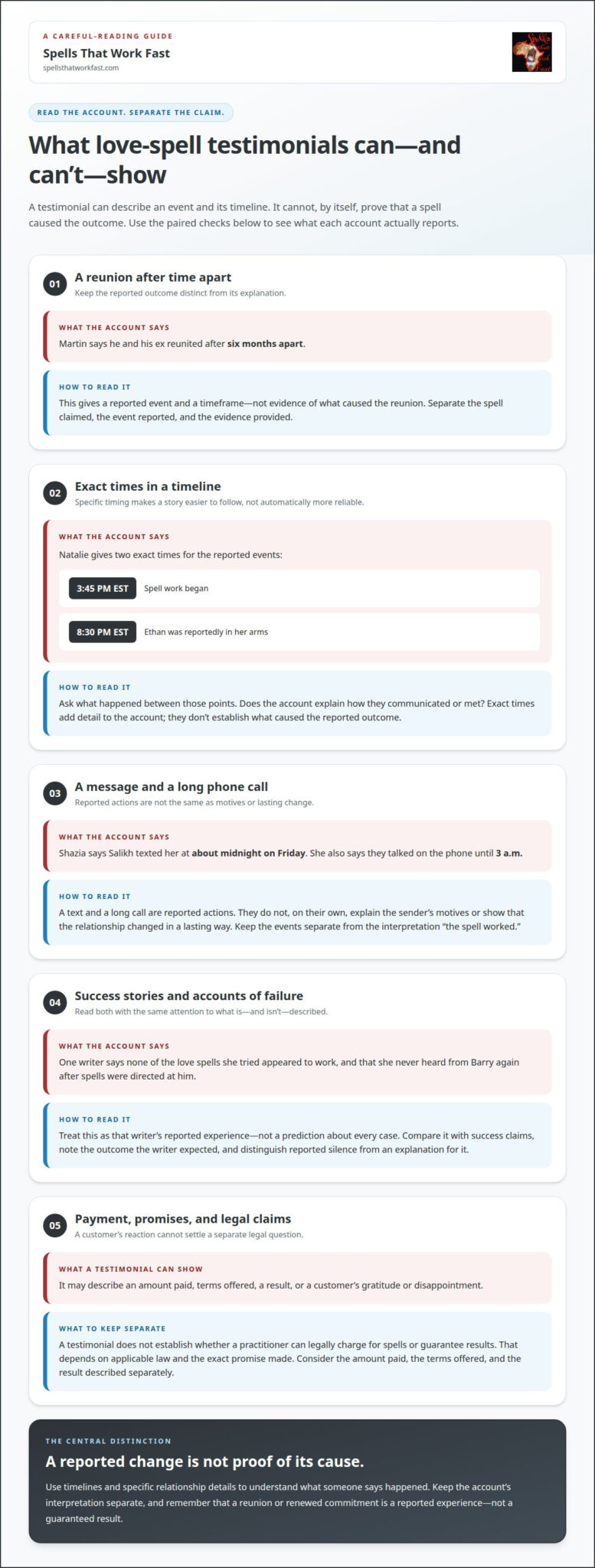
- Separate the event from its explanation. Martin’s account says he and his ex reunited after six months apart. This gives you a reported outcome and timeline, but doesn’t establish what caused the reunion. Note each element separately: the spell claimed, the event reported, and the evidence offered. If a testimonial describes only a change, don’t treat that change as proof of cause.
- Check how specific the timeline is. Helen’s ex reportedly returned after several months apart, while Natalie gave exact times: spell work began at 3:45 PM EST, and Ethan was in her arms by 8:30 PM EST. Specific times make an account easier to understand, not automatically more reliable. Ask what happened between those points, and whether the story explains how the people communicated or met.
- Look for relationship context. Shazia reported that Salikh texted her at about midnight on Friday. She also said they talked on the phone until 3 a.m. Notice the concrete events, then distinguish them from interpretations such as “the spell worked.” A message and a long call are reported actions. They don’t, by themselves, explain the sender’s motives or establish lasting change.
- Keep legal claims separate from results. A testimonial doesn’t establish whether a practitioner can legally charge for spells or guarantee results. That depends on applicable law and the exact promise made. Consider the amount paid, the terms offered, and the result described separately. A customer’s gratitude or disappointment cannot settle the legal question.
- Read accounts of failure as carefully as success stories. One writer said none of the love spells she tried appeared to work, and she never heard from Barry again after spells were directed at him. Treat this as her reported experience, not a prediction about every case. Compare it with success claims, note the expected outcome, and distinguish reported silence from an explanation for it.
Customer recommendations and expressions of gratitude
- Identify exactly what the customer recommends. “I recommend this practitioner” tells you the customer approves, but not why. Look for the specific service, experience, or interaction they mention. For example, “I recommend the clear instructions” describes a service detail, while “everything was amazing” gives you little to assess. Separate praise for communication from praise for an outcome.
- Read gratitude as a personal response. “Thank you for helping me feel hopeful” expresses emotion, while “my partner and I agreed to talk” describes an event. Both statements can appear together, but they mean different things. Note what the customer is grateful for, then identify any concrete action or change in the account. Enthusiastic wording alone isn’t a detailed recommendation.
- Examine money-related statements closely. That wording describes an intention, not a completed payment. In a similar account, distinguish a promised bonus from money actually paid, and separate financial gratitude from claims about relationship results.
- Look for reasons behind endorsements. A useful recommendation might explain that a practitioner answered questions clearly or described what to expect. Treat these as examples of what to look for, not claims about a specific customer. In an actual testimonial, note the stated reason, the experience it refers to, and whether the writer gives enough context to understand the praise.
- Compare the tone with the details. A strong thank-you can feel sincere, but intensity alone doesn’t explain what happened. For example, compare “I’m grateful” with a fuller account naming the conversation, advice, or relationship change that prompted that feeling. Use that distinction to assess each recommendation calmly. For a closer look at the service behind these accounts, explore love spell information.
One testimonial says Martin and his ex were back together after 6 months apart. The page recommends repeating its pink candle spell on 7 consecutive Fridays and its no-ingredient love spell on a full-moon night that falls on a Friday, or Every month on full-moon nights. Honey jar instructions say burn the candle for at least three nights; red candle attraction instructions say light it each evening for three nights.
Reported relationship reconciliations
- Define what “reconciled” means in each account. A message from a former partner is different from an agreement to restart a relationship. Look for the action described, such as a conversation, mutual decision, or renewed commitment. If a story only says “we got back together,” note that it doesn’t explain what each person chose or whether both describe the relationship the same way.
- Separate reunion timing from lasting change. One writer said a friend became interested in her about six years after she cast a love spell. This describes a delayed change in interest, not necessarily a reconciliation or proof of cause. Note the time gap, the reported event, and what the story says about the relationship afterward.
- Track both people’s actions. A reconciliation account is clearer when it describes what each partner did, not just what the writer hoped would happen. Distinguish one person reaching out from both people choosing to rebuild contact. Look for mutual participation, direct communication, and a stated decision instead of treating one gesture as a complete reunion.
- Check whether the account follows the relationship beyond the reunion. A reported return describes one point in time. Details about later communication or shared decisions provide more context. If a story ends immediately after the reunion, treat its claim as limited to that moment. Don’t infer lasting trust, commitment, or stability unless the account describes those developments.
- Compare the claimed result with the original hope. Someone seeking renewed contact may consider a message a success, while someone seeking a committed partnership may expect more. Write down the desired outcome, then compare it with the event reported. This simple step helps prevent a powerful reconciliation story from promising more than its details support.
A reported contact can be recorded without treating it as a mutual decision to reunite. Shazia reported that Salikh texted her at 12 midnight on Friday; that account identifies a message and its timing, but does not by itself describe what either person decided about the relationship. Keep the reported action distinct from any broader claim of reconciliation.
Jan said she had experienced 7 weeks of improved commitment in her relationship with Mark. That account describes a period and a change in commitment, so note both without assuming what happened before or after those 7 weeks.
Testimonials about love and commitment spells
Common warning signs include guaranteed reunions, pressure to pay more, and claims that only urgent action can help. Treat these as reasons to pause and carefully assess the wording, terms, and information requested.
Love spell services may involve personal relationship details and payment information. Share only what’s needed, never send account passwords, and consider how an intimate story could be used before submitting it.
- Define the commitment being described. Jan reported seven weeks of improved commitment with Mark. Look for what “improved” means in her account: more communication, clearer intentions, or another specific change. Without an observable example, the phrase expresses her view but leaves the change difficult to assess.
- Separate affection from commitment. A testimonial saying “we feel closer” describes an emotional impression. A claim about commitment should explain the action behind it, such as an agreed plan or a direct conversation about the relationship. Keep these outcomes distinct rather than treating affection as proof of a lasting promise.
- Look for both partners’ choices. Read for concrete details about what each person said or did. A story describing one partner asking to talk differs from one describing a mutual decision to rebuild the relationship. This distinction helps you judge whether the account supports its claim about commitment.
- Notice pressure in the recommendation itself. A testimonial urging readers to act immediately or pay for additional work is a reason to slow down. Assess the specific account separately from its sales language. A personal endorsement doesn’t establish that the same service or outcome will suit your circumstances.
- Protect private details before sharing your story. Remove identifying information about Mark, a partner, or other people unless it’s essential to your account. Keep payment details and passwords private. If you’re considering a love-focused service, explore love spell options and decide what personal information you’re comfortable sharing.
Spells That Work Fast: Instant Love Spells That Work Fast
Spells That Work Fast offers Instant Love Spells That Work Fast for people seeking spiritual support around love and commitment. Consider this option if you’ve assessed personal accounts and want to explore spell work for your situation. Testimonials can show what other customers say, but each is one person’s experience, not a promise that your relationship will change the same way.
Before taking a next step, be clear about what you hope for and which private details you’re comfortable sharing. Keep the other person’s choices in mind as you decide what feels right for you.
To learn more, visit Spells That Work Fast.
Choose Your Next Step With Care
Let love spell testimonials inform your thinking, not make the decision for you. Your next step should reflect what you want, what you’re comfortable sharing, and what you can approach with a clear head. Ground your expectations in your circumstances and the choices of everyone involved.
Spells That Work Fast offers Instant Love Spells That Work Fast, Powerful Money Spell To Attract Wealth Instantly, and Spells For Business Growth Support and Success. If you want to focus on love, explore that offering and consider whether it fits your intentions.
No testimonial can promise the same outcome for another person. Take time to decide what you’re seeking, then choose a next step that feels right to you. Contact Spells That Work Fast to discuss your interest. Move forward thoughtfully, with your hopes and boundaries in view.
Frequently Asked Questions
What do love spell testimonials typically claim?
Testimonials commonly claim that an ex returned, communication resumed, affection grew, or a partner showed greater commitment. Read each account for the exact change described, how the writer defines success, and whether it concerns a brief event or an ongoing shift. A message, a reunion, and lasting commitment are different outcomes, so don’t treat one as evidence of another.



 WhatsApp Here