

A familiar name is not proof of a trustworthy spell caster. A love spell is a magical practice intended to conjure romantic love or sexual attraction, and a spell caster is someone trained to perform it. Authentic love spellcaster reviews can offer clues, but a persuasive testimonial alone can’t establish what to expect.
It makes sense to look for clear signs of experience, personal attention, and honest communication before taking any claim seriously. This guide explains how to research a caster’s name and background, assess whether their approach is personalized, and read reviews for detail, balance, and consistency. You’ll also learn why absolute promises and pressure deserve caution, and why testimonials describe individual experiences rather than predictable outcomes.
Key Takeaways
- Research a spell caster’s name and business details together to see whether the identity and claims remain consistent.
- Look for clear explanations of experience and how the practitioner tailors their approach to an individual situation.
- Compare review details across platforms, and treat absolute success claims or testimonials as personal accounts, not proof of predictable results.
- Take pressure or threats seriously, and consider whether the approach respects consent and personal choice.
Researching spell caster names and businesses
A love spell is a magical manifestation intended to conjure romantic love and sexual attraction. A spell caster is described as someone trained to cast one. Start with the exact name shown on a business page, then compare its spelling and identity across its other pages.
Spellcasters, relationship counselors, and spiritual advisors have different roles. Spellcasters perform ritual work focused on romantic concerns. Relationship counselors address relationship issues and communication, while spiritual advisors offer guidance rooted in spiritual beliefs. These approaches are not interchangeable, even when someone seeks support for the same situation.
Spiritual titles can also refer to different traditions. Clerics are associated with prayers to their gods, while druids connect with spirits through places such as forests or caves. Seers are associated with sensing future events. In the described tradition, a wizard uses wands and staves to connect to the Nexus. These labels suggest different practices, not proof of expertise or results.
- Search the exact practitioner name, including middle initials or alternate spellings.
- Compare the name on the profile, business page, and testimonial attribution.
- Note whether the business explains its practice in plain terms, such as prayer or ritual.
- Separate a practitioner’s stated approach from claims about what it can achieve.
For example, if a profile uses “Jordan Lee” but a testimonial names “J. Lee,” the difference alone proves nothing. Look for a clear explanation connecting the names. A consistent identity makes claims easier to assess; vague or shifting identities make it harder to know who stands behind the service.
Read the written cancellation and refund terms before ordering. Ritual preparation or casting may affect whether a change-of-mind refund is available, and applicable consumer law may also matter. Don’t assume a refund or recast is included. If additional work is proposed, clarify whether recasting is available and understand its terms before agreeing.
Verifying practitioner experience and personalization
A clear experience claim should explain what the practitioner did, not just how long they have practiced. Mary began working as a professional spell caster and psychic when she was 14 years old. That detail gives readers a specific starting point, but age alone doesn’t establish skill, judgment, or the quality of someone’s work. Look for a clear description of the practice behind the claim.
Personalization is another useful test. A tailored approach should relate the practitioner’s explanation to the situation being discussed, rather than rely only on a broad promise. For example, a response that recognizes whether someone seeks renewed affection or a closer bond is more specific than a message that could fit any relationship. Specific language shows attention, but cannot prove an outcome.
Assess experience and personalization through details such as:
- Practice history: Does the practitioner explain when their work began and what it involves?
- Relevant experience: Does the description address love-focused work, rather than relying on unrelated spiritual claims?
- Personal attention: Does the explanation reflect the situation, or repeat the same wording for every person?
- Clear limits: Can the practitioner explain what the ritual involves without promising control over another person?
Compare the practitioner’s public description with the language used in reviews. If the profile stresses personal attention but testimonials repeat identical phrases, consider that mismatch. A review describing a specific concern and explaining the practitioner’s response gives more context than a brief claim of success. Neither proves an outcome, but both help you judge how clearly the work is described.
Separate a service update from a promise about a relationship. Ritual preparation describes an action; it doesn’t establish what another person will feel or choose. Experience can explain a practitioner’s approach, while personalization shows how it relates to an individual concern. Keep these signals distinct from claims that imply certainty about someone else’s romantic choices.
Assessing authentic, balanced reviews
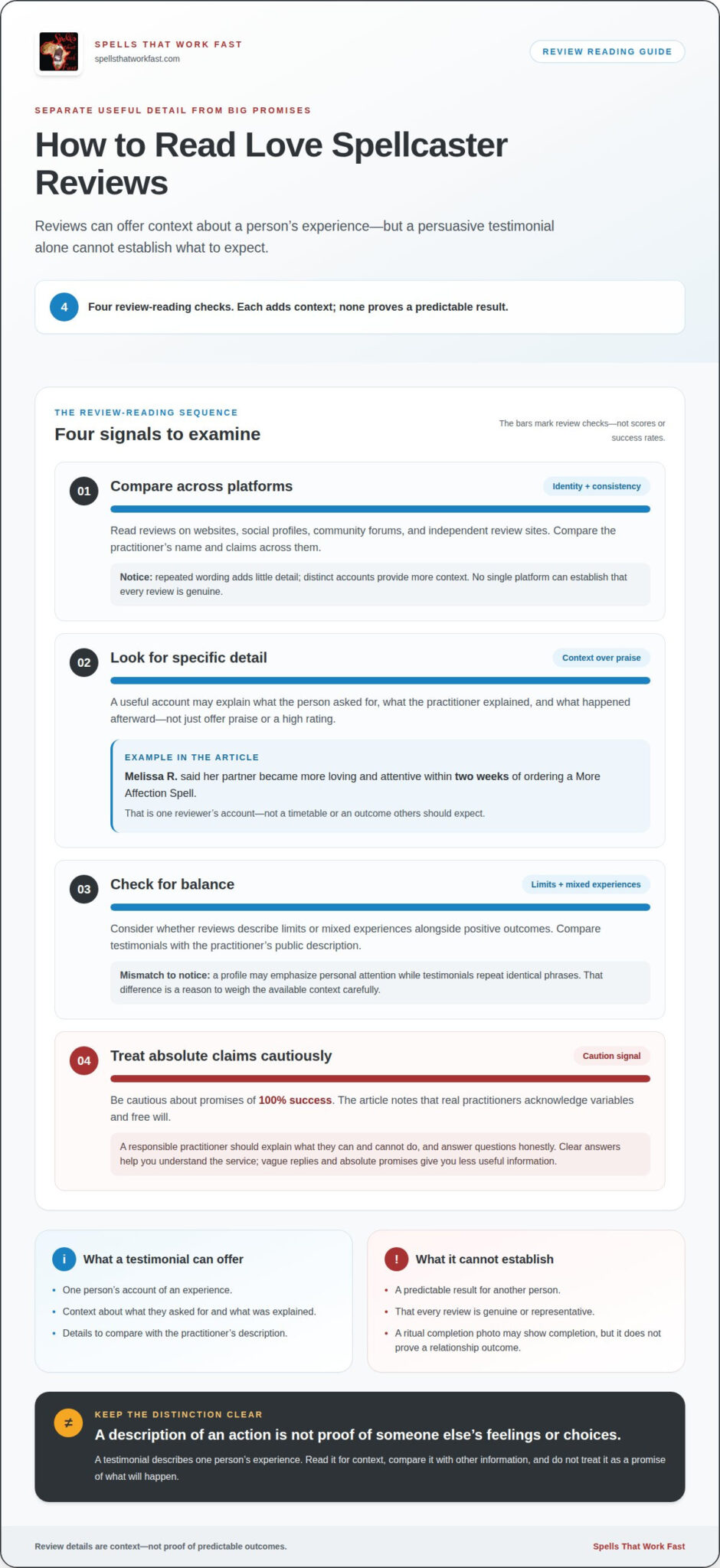
Read reviews across websites, social profiles, community forums, and independent review sites. Compare the same practitioner’s name and claims across platforms. Repeated wording adds little detail; distinct accounts describing different experiences offer more context. No single platform can establish whether every review is genuine.
Look for specifics rather than praise alone. A review might describe what the person asked for, what the practitioner explained, and what happened afterward. For example, Melissa R. said her partner became more loving and attentive within two weeks of ordering a More Affection Spell. That is one reviewer’s account, not a timetable or an outcome others should expect.
- Compare platforms: Check whether reviews appear across several kinds of sites and profiles.
- Read for detail: Notice whether the account explains the experience, not just whether it gives a high rating.
- Look for balance: Consider whether reviews describe limits or mixed experiences alongside positive outcomes.
- Assess claims: Treat promises of 100% success cautiously; real practitioners acknowledge variables and free will.
Pay attention to how the practitioner responds to questions. A responsible love spell caster should explain what they can and cannot do, and answer prospective clients honestly. Clear answers help you understand the service. A vague reply or absolute promise gives you less useful information to weigh.
Separate evidence of an action from evidence of a relationship outcome. A testimonial describes one person’s experience. A ritual completion photo may show that a ritual was completed, but neither proves a predictable change in another person’s feelings. Relationship outcomes have no fixed timetable, so service updates should not be mistaken for promised results.
Consider the overall pattern, not one glowing comment. If an account describes a specific experience, compare its details with other platforms and the practitioner’s explanations. Balanced reviews can help you assess what people report while leaving room for individual circumstances and personal choice.
What risks or harms are associated with hiring a love spellcaster?
Emotional pressure is a serious warning sign. Someone facing a breakup may feel desperate for certainty, and a threatening message can deepen that distress. Treat threats from an online love spell caster as a sign of possible fraud. Don’t let fear push you into a rushed decision or further engagement.
Watch for pressure that turns one request into repeated demands for more work. For example, a practitioner might claim another ritual is urgently needed, then imply something bad will happen if you refuse. Pause and revisit the written terms. Consider whether the explanation is clear, relevant, and free from intimidation. A responsible practitioner should answer questions honestly, not use fear to silence them.
Consent matters, too. Ethical love work respects free will and avoids coercion. Asking to make a specific person act against their wishes conflicts with that principle. Notice whether the practitioner acknowledges personal choice or promises control over another person. A ritual or testimonial cannot establish that someone else’s feelings or decisions can be directed.
- Threats: Stop engaging with messages that use fear or intimidation to demand action.
- Escalating pressure: Reassess any new request framed as urgent or compulsory.
- Coercive claims: Be wary of promises to override another person’s choices.
- Unclear terms: Read the written conditions before agreeing to additional work.
Keep your boundaries firm. Share only the information needed to explain your concern, and don’t disclose account passwords or financial access details. Save threatening messages so you can review exactly what was said, rather than relying on memory of a stressful conversation. If communication feels unsafe, stop replying and seek support from someone you trust.
Choose a next step without pressure. If you want to explore a love-focused spiritual service, review your love spell options and consider whether the approach respects consent, answers your questions, and lets you decide freely.
Spells That Work Fast: Instant Love Spells That Work Fast
Spells That Work Fast offers Instant Love Spells That Work Fast for people seeking love-focused spiritual work. It may suit you if you’ve considered spellcaster claims and want to explore a spell focused on romantic concerns.
Keep your expectations grounded. A service description explains its intended focus, while reviews reflect individual experiences. Neither establishes a predictable outcome or control over another person’s choices. Use the same standards from this guide: look for clear explanations, respectful communication, and room to make your own decision.
If this approach fits what you’re seeking, contact Spells That Work Fast to discuss your interest.
Choose Your Next Step With Clarity
Let your decision reflect what matters to you, not the urgency of someone else’s promise. Treat authentic love spellcaster reviews as one perspective, then decide whether the approach feels respectful and right for your situation. No review or ritual can guarantee another person’s choices.
Spells That Work Fast offers Instant Love Spells That Work Fast, Powerful Money Spell To Attract Wealth Instantly, and Spells For Business Growth Support and Success. If you want to explore love-focused spiritual work, make your decision with your boundaries and expectations clear.
Contact Spells That Work Fast to discuss your interest. Move forward at your own pace, with confidence in the choice you make.
Frequently Asked Questions
What Is A Love Spell, And Who Is a Spell Caster?
A love spell is a ritual or spiritual practice intended to focus on romantic love or attraction; a spell caster performs that work. The title describes a role, not proof of expertise. Someone seeking spiritual direction may want guidance, while someone seeking spellcasting is looking for ritual work. Neither should be confused with relationship counseling or professional mental health support.
What do reviews say about authentic love spellcasters?
Reviews offer individual accounts of a practitioner’s communication, service, or a reported relationship change. To read authentic love spellcaster reviews carefully, separate what the reviewer directly experienced from what they believe caused it. A reviewer might describe receiving a ritual update, but that does not establish why a partner later behaved differently. Treat each account as a personal perspective, not a universal finding.
How can you verify a love spellcaster’s credentials and authenticity?
Look for a consistent professional identity and specific descriptions of practice. If a practitioner names a school, organization, or certificate, assess whether the claim explains what was completed and what it covers. Ask direct questions about the process and expected communication. A clear answer explains the service plainly, rather than using impressive titles as a substitute for useful information.
What are common signs of love spell scams or fake reviews?
Warning signs include threats, pressure to act immediately, and absolute claims that every spell succeeds. Reviews deserve closer scrutiny if several use nearly identical wording or make sweeping promises without describing an actual interaction. For example, demanding more work while warning of harm uses fear, not clear service information. Pause rather than agreeing under pressure.
What do customer reviews say about popular love spellcaster services?
Spells That Work Fast features real-life testimonials from people who tried its love spells. These are personal accounts, not a guarantee that another person will experience the same result. Its listed services include Instant Love Spells That Work Fast and Bring Back EX Love Spells. Read each testimonial as one person’s report, not as a promise about what will happen in another relationship.
Do love spellcaster reviews show reliable evidence that spells work?
No. Reviews can show what a person says they experienced, but they cannot prove that a spell caused a relationship change. A partner becoming more attentive, for instance, does not by itself identify the reason. Ritual photos may document a ritual, but they cannot predict someone else’s decisions. Use testimonials to understand reported experiences, not as proof of cause or future results.